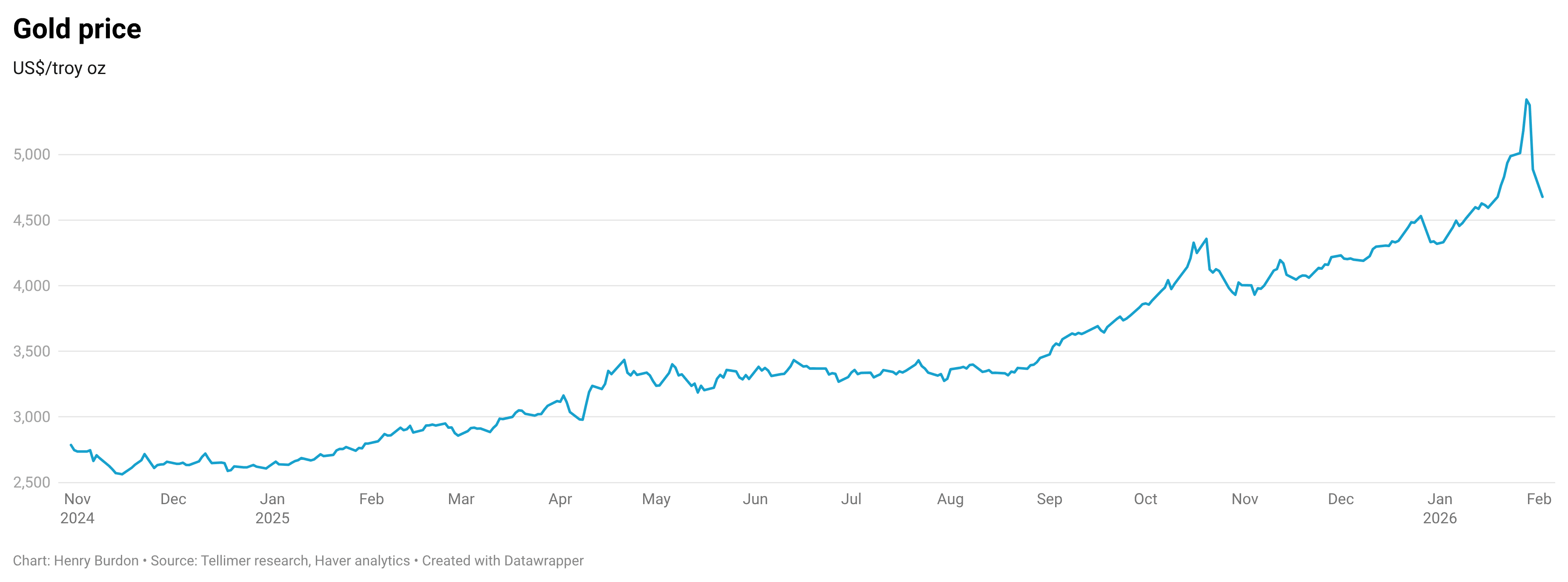
Recent gold price corrections highlight the risks of having concentrated reserve exposures
Rising gold volatility increases reserve valuation risk, especially for those with otherwise fragile external buffers
We take an expanded look at gold reserve concentration and reserve coverage across the frontier universe
The most direct channel through which fluctuations in gold prices affect sovereign balance sheets is via valuation changes in international reserve holdings. Exposure to gold proved a macro tailwind for the most gold-exposed countries in 2025, particularly those with otherwise fragile external buffers. However, the roughly 14% correction in spot gold prices in recent days serves as a reminder of the risks associated with holding high concentrations of sovereign wealth in any single asset.
What’s more, a marked rise in gold price volatility over recent months – with gold volatility converging with that of Bitcoin in recent days (albeit still well short) – suggests that regardless of direction, policymakers must adjust to an environment in which sharp swings in reserve valuations become more common. This may, in turn, have implications for how sovereign liquidity positions are managed.
To assess this exposure more comprehensively, we expand our dataset from November to include a broader set of frontier markets. We supplement World Gold Council (WGC) data with national sources, IMF statistics, and our own estimates where necessary. The WGC data itself is drawn primarily from the IMF’s International Financial Statistics (IFS) database and reflects observations from September–December 2025, unless otherwise noted.
Read the full report on the Tellimer App

Henry Burdon is an economist @ Tellimer covering Emerging Europe and CIS.